3 Major Updates in the New Google Search ParadigmPost from: Quality SEO Services & Link Building Services Google has come a long way since its humble beginnings as a Stanford University research project in 1996. While the company has ventured out of its algorithmic search roots, Google is still synonymous with search -one of the [...]
I admit it. I am jaded. I don’t laugh at the things that many people find funny because it never feels as funny to me as it does to them. But this new Old Spice ad / campaign or whatever you want to call it made me laugh. Yeah, I literally LOL’d. Stick around for [...]
On any bigger site, you’ll get archive pages of some sort. Whether they are taxonomy or category archives, like this SEO category, Custom Post Type archives like this one for our WordPress plugin reviews�or my speaking engagements,�or even date archives: they all share the same common traits. In WordPress an archive will, by default, consist…
Google+ has been looking for a way to distinguish itself from the competition. They tried with their unique video chat system called Hangouts. They tried with a group photo upload option called Party Mode. And now they’re trying again with a new series of features designed to turn their site into your office conference room. [...]
Facebook had their first tranche of insider lock ups expire yesterday & the stock ended off over 5%. Anyone who has ever invested for a significant period of time knows what the following graphic looks like: the collapse of a bubble.
What has caused such a poor performance for Facebook?
At some point with fresh IPO companies a declining stock price becomes a self-reinforcing cycle which makes it harder (and more expensive) to attract & retain quality employees.
If you want to invest in "the next Google" at a valuation above $100 billion then the best way to do so is to buy Google.
I won't claim that Google's growth there has also passed through to online publishers. It many cases it has not, as Google has begun dominating their own results & pushing competitors below the fold.
Unless you are already well trusted or are willing to hack websites, brute force SEO is getting much harder. Even getting a boatload of exposure like the following graph shows may have zero impact on Google rankings.
Out-of-context facts only need to sound good in 140 characters.
Reputation Management
Occasionally a company can be so idiotic that their Progressive(ly) incompetent behavior creates a categorical example of failing their customers. But that sort of failure only matters if it gets shared frequently on blogs & media sites off the social media platforms.
Most Tweets are largely forgotten after a few days. A bad search result can create a progressive self-reinforcing problem that lives on as long as a brand does.
The problem with social media is that it's performance hasn't been particularly stellar thusfar & they have only just begun to start screwing over people playing on their platforms. A big part of what caused Zynga to miss so badly on their last quarterly result was:
"Facebook made changes to their platform that favored new game discovery," he said. As a result, Zynga users "did not remain engaged and did not come back as often."
It is not just Facebook that is locking down their ecosystem. Twitter is headed down the same path: "I sure as hell wouldn?t build a business on Twitter, and I don?t think I?ll even build any nontrivial features on it anymore."
There is a difference between targeted search traffic & the stuff that people sell as "unlimited traffic for $6."
Social media can drive some conversions with coupons, but it can also make people (who would have converted anyway) expect coupons and discounts to purchase. Part of the problem with attributing anything to social media is so much of it can be attributed to activity bias. Anyone who follows you & similar business & so on is going to be more likely to convert in those areas. That they at some point in time were on a large social network doesn't mean that the social network added any value to the sequence or caused a conversion.
Even if you know exactly how influential people are it still wouldn't mean that you would be able to influence them (generally the more popular someone is the less receptive they are to pitches). And generally speaking traffic on your site is worth more than traffic from social media sites, as it is already more targeted. This is why traffic exchange systems suck...those atop the pyramid suck most the real value out of it while those lower in the system give away their visitors for scraps.
The #1 rule of online traffic is that relevancy is more important than volume.
False Sense of Closeness & Empathy (Cuts Both Ways)
Online petitions have a low cost (go nowhere & click a mouse), so even in large numbers they usually don't mean much. Whereas people who go through barriers to entries & jump over hurdles are far more committed to a goal.
With sites like Twitter there can be a wow factor in that there is a false sense of closeness, but in reality many celebrities pay others to tweet for them and sell tweets.
And every bit as fake as the "celebrity who really cares about you" there are also the enragednon-customers who try to leverage social media to level the playing field. But in most cases those were never going to be good relationships anyhow. For most people the best solution is to ignore them.
Hits Can Be Somewhat Unpredictable
In addition to the fickle here today, gone tomorrow nature of social media, the results are typically quite unpredictable. What is even more challenging is that you can optimize for relevancy or virality, but to try to guarantee one you usually have to sacrifice signifcantly on the other. That means that either you can get links & audience, or you can create some conversions, but it is quite hard to do both.
It is easy to point to success like Double Fine & Ouya as proof of the power of some of these networks, but some of that success is due to past success. Anyone who loved playing Psychonauts would love to invest in helping to create another release.
P&G can lay off some of their marketing department because their brands already have such a strong share of voice across all mediums.
Mainstream media writers can offer tips on how to have a dead cat bounce on Twitter. That isn't so hard for the mainstream media to do given how much they dominate Twitter trends & the top shared stories on Facebook. However if you don't have an organic audience channel & a built in cumulative advantage then likely either your story will go nowhere, or even if you share something great what will end up happening is someone else with more distribution will rewrite your story and displace you as the lead source.
Social media can have value as a signal amplification tool, but if you do not already have a separate audience base (via email, RSS, or some other similar channels) then time spent on social would likely be better spent building up some of those other channels first. If you are not building off an organic audience channel then social media promotions will typically fall flat.
Dominate a Small Pond
I don't think I would have done well with SEO if I spent most of my time on the largest sites when I was new to the industry. What helped me along was joining the great crew on SearchGuild who taught me a lot in a short period of time. On smaller sites we can become a bigger fish in a small pond.
The fatal attraction with large sites is that the audience is large, but it is largely inaccessible. The largest sites are the most interest to people who are the least interesting people. Or, put another way, we are most alike where we are the most vulgar & the most unique where we are the most refined.
Twitter allowed spam & had few people employed fight it. Why? More "users" equates to a higher growth rate, which equates to a higher market valuation on subsiquent investment rounds. Twitter stated that in 2009, 11% of their tweets were spam.
During a social media ponzi bubble a whitepaper about Twitter of Facebook has sizzle because it allows you to leach off the story of that broader platform. And so long as those companies are raising money or trying to go public they want to show the maximum growth possible, so they are unlikely to crack down on forms of marketing manipulation that help growth their platform size and valuation. After they are public though & growth has slowed their approach toward controlling their platform will become much more adversarial.
Google has been public for nearly a decade now & if you speak in the language of SEO that is a term that has already been well defined through the dominant market player.
A Desire to be Seen as a Broader Service
If you are only seen as being about "SEO" then anytime Google forces drastic changes onto the market you are seen as being of limited value & thus at great risk of being washed away. This is even more risky if you are leveraging up and trying to raise funding. But if you claim to be more generalist it allows the frog to turn into a prince, as you have more "growth" opportunities in the near future.
Give it a Different Name
A lot of people try to slag off SEO for self-promotion & then say "don't do spam like the SEOs, instead do x."
And if you read off the list of items that are represented in the "x" invariably it reads like an SEO checklist.
So why do people try to redefine SEO? A number of reasons:
if they can create a new term that they "own" then anyone who shares it is building the value of their company
they can use polarizing marketing to capture attention & then differentiate themselves from what they actually do by claiming to be doing something else
some of the most egregious SEO spammers (eg: Jason Calacanis) never could have got away with running their projects as they were without first distancing themselves from the SEO market
The MLM Factor
In most MLM schemes step 1 is often "follow us" with step 2 being "spread our message" (or, feed us your young, get your friends to hate you, sell your soul, etc.)
This same factor is baked into social media services. Rather than going directly to money though it uses attention as an intermediary.
I am not saying that asking people to follow you is necessarily bad, but if you tell people that social media will change the world and that they should follow you for tips then of course that is a great way to get a bunch of desperate, ignorant & shameless newbs to syndicate your spin. If those people are re-defining old school SEO techniques using a new vernacular they are both the customer (buying into the re-marketing of old concepts) and the product (evangelist spreading false gospel & generating social proof of value).
The above message is never stated in the various "correlation analysis" charts that aim to prove the value of social media to SEO.
There are loads of ways to create a core baseline social "signal" on the cheap. Newt Gingrich was called out for having some fake Twitter followers. There are boatloads of services & tools out there targeting all the social networks & free hosts: Facebook, Twitter, MySpace, YouTube, Blogspot, Wordpress, Tumblr, StumbleUpon, Reddit, Digg, Pligg, and even Pinterest.
Given how Newt got "called out" for having fake followers, I wouldn't be surprised to see some marketers buying fake followers for other convenient targets to create a story to sell.
Selling a Bag of Smoke
While composing this, a spam email hit my inbox stating the following:
It's a fact: more people find out about your business on Facebook or Twitter than on search engines. Making these sites work maybe tricky for you, but it s business as usual for us. Let us improve your visibility and enhance your image. It s part of our complete Internet Marketing package. We ll be more than your friends --- we ll be your partners."
Social metrics are easily gamed. If you just want numbers not only are they sold by the social networks as ad units, but they can be had in bulk on sites like Fiverr.
Probably the best comment I have ever read about the "bag of smoke" concept was from Will Spencer:
SEO's like to sell social signals as ranking factors because social media marketing is an easy product to deliver while collecting good profit margins.
The fact that it doesn't work... doesn't seem to bother those people.
The "good guys" in the SEO business aren't the people who parrot Google's lies to a wider audience; the "good guys" in the SEO business are the guys who make their clients money.
Even more laughable than SEOs selling social media as the key to SEO is their open ignorance of the political nature of various relevancy signals.
Does Facebook sell likes? Yes. Why would Google want to subsidize a competing ad network? It isn't hard to notice Google's dislike for Facebook through their very public black PR campaigns.
The same sort of "why would I subsidize a competitor" issue is also in place with Twitter. They sell retweets & follows, so why would Google want to subsidize that?
Sometimes parody can be a great teaching tool. Don’t miss the Condescending Corporate Brand Page for a steady stream of reminders of how not to be annoying with your Facebook Page. Brilliant. I love it.
Web Designers, Agencies, & Marketing Firms: Work with us to deliver the best local search results for your clients and earn commissions. Expert, accurate, U.S.-based team will claim, verify and enhance your client's business listings and more. http://localsearchoptimization.com
They say three’s a charm and that’s certainly true with the third installment of our series investigating the top content marketing “secret agents” that will be presenting at Content Marketing World next week. “Mums the word” might be tricky with this one, since the data is coming from secret agent Michael Brenner, Senior�Director of Integrated [...]
For travelers the smartphone becomes even more important than it usually is. On the go folks aren’t as prone to carry around a laptop and be slave to a Wifi connection especially when a smartphone can deliver the data they need just about anywhere and at any time. But when it comes to how they [...]
Content strategy has always been a valued part of SEO and, with Google?s recent updates, it?s become increasingly important. No matter what size your business is, having a regular flow ...
There are over 169.3 million people who watch Internet videos regularly, and YouTube is now the second largest online search engine. People love video, and it’s crucial to take advantage of that if you’re in marketing, business, or blogging. We’re a big believer that every business can leverage video?it only seems daunting. To break it [...]
Getting visitors to go through your blog and enjoy what you have written isn’t the easiest thing on the planet. It requires time, patience and a lot of practice. To ...
No this title wasn’t a pun. It’s dead serious. My buddy Arjan�discovered yesterday that Google is now allowing rel=”author” markup through a <link> element in the head of your site. This makes adding rel=”author” to your site properly a lot easier, and allows me to add it to my WordPress SEO plugin. The rel=”author” link…
“Looking for that epic shot from last winter?s ski trip?� Or the I-could-die-laughing photo of your roommate?s cat dancing?” No? Too bad, Bing is going to help you do it anyway with their brand, spanking, new Facebook Friends’ Photo Feature. (Say that three times fast!) The widget, which resides on Bing’s website, gives you a [...]
Most Effective Advertising Online In 2012 [Infographic] This recent infographic from Webstarts takes a look at online advertising in 2012. �With billions of dollars being spent on advertising each year it is difficult for some marketers to determine where their advertising dollars should be spent. Facebook Testing Sponsored Search Ads – Google AdWords Watch Out? [...]
Everyone likes free stuff, right? A proven method in boosting followers, social media contests are nothing new. However, the popular platforms and rules to follow are always changing, so it’s important to evaluate your options regularly. Here, we take a look at the leading social media site, Facebook, and the ever-growing new kid on the [...]
Although I wouldn?t usually use the blog for this, I thought I?d give you a quick update on the recent changes here at SEOptimise. As you may have heard, my ...
This guest post is by Jared Latigo. I’ve come across possibly hundreds of articles from prominent sites around the web that tackle the 10, 15, or 101 reasons your blog isn’t getting the traffic it deserves. But the interesting thing is that none of the ones I’ve found mention the real reason, the core reason, [...]
Let’s take a brief walk down memory lane. We went from arcade games to Pong, to Nintendo 64, to Kinect and now games you can download and play instantly on your phone while on the go. On the go phones, used to mean a phone booth then people with money had car phones with a [...]
Lately, you might have noticed Google’s aggressive and frequent product announcements. With so much going on at Google during the past few weeks such as Google’s Penguin algorithm update, the ...
Are you afraid that you’re missing out on an important event? Concerned that you won’t know what’s being discussed around the water cooler tomorrow? Worried that something is happening in the world right now that you don’t know anything about and that you’re missing out on some very lucrative keyword opportunities? Worry no more! Here [...]
In PPC, the context is in the mind of the searcher. When we search for something, we know what we mean, but a search engine may not. As a result, especially with one-word queries, you fall into the ambiguity trap. Fortunately, there are solutions.
You know, once a great secret spreads, you get all kinds of “wannabe” corporate marketing types creating what they think is great content. And you know what? Most corporate content is flat out boring. �It’s all about “me me me”. �The best Content Marketing secret agents understand that it’s not all about the brand, it’s [...]
We?ve now lived with Google Plus for a little more than a year and I want to ask an important question: can we hit a big ?reset? button on Google Plus? I don?t mean on the social network itself, but rather the way we, as marketers, think about and approach the platform. There is not [...]
The rapid changes in the search industry over the last sixteen months have left many web publishers wondering whether they should pivot their business models or exist the industry entirely. This is a difficult question for business owners who have invested years of their lives and much of their wealth in firms which may no longer be viable contenders in the "new" search industry.
SWOT analysis is a technique which business owners can use to strategically analyze their businesses in relation to their competitors and the marketplace as a whole. SWOT stands for Strengths, Weaknesses, Opportunites, Threats.
Strengths are attributes of the organization which provide an advantage in the marketplace.
Weaknesses are attributres of the organization which cause a disadvantage in the marketplace.
Opportunities are actions the organization could take to create an advantage in the marketplace.
Threats are events which could happen in the environment and cause the organization to be disadvantaged.
The first two areas, Strengths and Weaknesses, focus primarily on the internal attributes of the organization. The last two areas, Opportunities and Threats, focus primary on how the organization may be affected by external events.
Specifics for Web Publishers
Many firms in the same industry will share similar Strengths and Weaknesses. Even more so, most firms in any industry will be responding to similar Opportunities and Threats.
Strengths and Weaknesses
Take a look at your organization. If you feel that your organization has an attribute which makes it stronger than it's competitors, add that to your Strengths list. If you feel that your organization has an attribute that makes it weaker than it's competiors, add that item to your Weaknesses list.
Access to Funding
Brand Recognition
Domain Authority
Industry Connections
Technical Skills
Marketing Savvy
Vertical Expertise
Examples of Strengths might include:
We have ready access to venture capital
We own a widely recognized brand name
We own a PageRank 8 domain
I have Matt Cutts on speed dial
Our technical team members are experts in our platforms, development tools, and applications
Our marketing team members can make linkbait about lug nuts go viral
We invented this niche and our competitors have no hope of ever catching up
Examples of Weaknesses might include:
Our working capital is limited to what's in my wallet
Our top domain is a hyphenated .us domain
We're hoping to gain PageRank at the next update
Matt Cutts blocked me on Twitter
Our technical team is outsourced to Pakistan
Our marketing team is outsourced to Bangladesh
I read a book about this niche and it seems very exciting
Opportunities and Threats
The same event might be an Opportunity or a Threat, depending upon how your organization can respond to it. Search is a zero-sum game. For every winner, there must be a loser.
Take a look at your organization. If you feel that your organization has the ability to benefit from a coming change in the business environment, add that to your Opportunities list. If you believe that your organization is at risk from a coming change, add that to your Threats list.
Our niche (travel, local, etc...) is being taken over by Google (unless you are Google)
Our niche is being persecuted (gambling, medication) or promoted (green energy, section 8 housing) by the government
Our niche is being regulated by the government, which benefits large companies and hurts small ones
Our niche is being increasingly dominated by the top brands (unless you are one of the top brands)
Our niche is growing (iPads) or shrinking (Blackberries)
Profitability in this niche is rising (medical training) or falling (almost everything else)
Some marketing tactics may be filtered or penalized (directory submissions, blog commenting, profile building)
Significant competitors are entering (or leaving) the niche
Examples of Opportunities might include:
Legislation could force consumers or businesses to buy our goods and services
Government regulation could force small competitors out of the market, and we're a large competitor
Google is increasingly ranking the top brands for all searches, and we're a top brand
Our niche is growing
Profitability in the niche is rising
Our marketing tactics are being increasingly rewarded by the search engines
Our niche has significant barriers to entry which prevent competitors from entering the market
Examples of Threats might include:
Legislation could make our business illegal in our country
Government regulation could force small competitors out of the market, and we're one of those small competitors
Google is increasingly ranking the top brands for all searches, and we're not a top brand
Our niche is shrinking
Profitability in the niche is falling -- unless you can operate on thinner margins than your competitors and take their market share when they fail
Our marketing tactics are being increasingly filtered or penalized by the search engines
One of our competitors just did an interview with Forbes bragging about the high profit margins in this niche
Responding to the Results of Your Analysis
After listing your Strengths, Weaknesses, Opportunities, and Threats you should have a pretty good idea where your business stands. From here, it's time to take advantage of this new knowledge.
The web publishing industry is currently undergoing a major contraction. Some organizations will choose to continue in this business, while others will choose to pivot into related business or to exit the industry entirely. AdSense publishers may decide to move into affiliate marketing or selling white label products. Web publishers may decide to halt development on their own projects and offer their services as SEO's to large enterprises. Entrepreneurs may simply close their companies and accept positions with larger firms.
If your niche is travel, which Google is slowly taking over and Wikimedia is considering a push into, you might consider moving to a different niche, pivoting your web publishing business into an SEO firm, or moving into the nascent eBook market. If your niche is 3D printers, you might seek funding to stake out early market share in a niche that may be about to cross the chasm from the early adopter stage of development.
If you have deep knowledge, experience, and connections in your niche, you might try to stick with it and be the last man standing after your weaker competitors have failed. If your knowledge is less niche focused and more related to publishing and marketing, you might sell SEO services or take a job with one of the huge multinational brands which Google is currently favoring in the SERPs.
If you have access to large amount of venture capital, you might take advantage of that to become one of the large brands which Google prefers to rank. With enough funding, anything can be ranked well in Google. I would caution, however, against entering a niche which is likely to be on Google's roadmap. Google, in being able to control the order of search results, has an unbeatable advantage in promoting their own properties (YouTube, Google+, etc...).
As margins in the industry are falling in our race to the bottom, you may even find a significant competitive advantage in having a lower cost structure than your competitors. Lower costs create larger amounts of retained earnings which can be used to fuel development and growth.
Summary
The two most important aspects of SWOT analysis are to be honest with yourself and to take action based upon your analysis. As Virgil wrote, fortune favors the bold. Be bold in your honesty and your actions and fortune will smile upon you.
Last month (June 2012), my 30 day challenge was to try to eat mindfully (eat more slowly, don’t eat while distracted by TV or web browsing, chew more, stop eating when I’m full, etc.). It turns out that eating mindfully is hard. I’m the sort of person that eats whatever is on my plate, so [...]
Most of us don’t get to choose what we write about. Your new client makes pollen-resistant underwear? Congratulations. You’re now an author specializing in allergen-repelling undergarments.
This setup sounds pretty funny until you have to write 15 blog posts per month for PollenProof™’s new marketing campaign. The idea well runs dry pretty quick. How do you keep your interest peaked and idea generator fresh? Random affinities to the rescue!
Random affinities
This term is 100% made up by me with a lot of help from some colleagues. I’m not so worried about protecting it – just beware that if you decide to use it and get laughed out of the room, your only reference is a sweaty, pale marketing guy who spends his spare time training his cats to play fetch.
Two topics have ‘random affinity’ if they are connected only by a common audience. For example: the fact that I like cycling may mean I’m four times more likely to watch "Adventure Time." There’s no subject connection between cycling and "Adventure Time" - Jake and Finn never ride a bicycle. The only connection is the fact that an unusual number of people are interested in both.
A few other (potential) examples:
Cyclists are more likely to own tablet computers.
Cyclists worry more about skin cancer and skin protection.
People who belong to a PTA or PTO are more likely to be aquarium or zoo members.
People who attend boat shows are more likely to watch extreme sports on TV.
Don’t overthink it. Two ideas + no obvious connection except audience = random affinity.
So what?
This is the part where you say: So what, Ian? You writing a new book or something? Why are you wasting my time with all this fake academic marketing crapola?
The answer is this: random affinities are another way to attract and keep your long tail audience. I don’t buy a bicycle every month (not for lack of trying). I buy one every few years. You can try to catch my attention at just the right time for a bike purchase. But you’ve got a better chance of selling to me if you catch and hold my attention throughout my bicycle buying dry spell. You can do that by speaking to the random affinity topics I like. I’m over 30, plus I sunburn under full spectrum lighting, so skin protection is pretty important to me when I ride. I own a tablet computer, as well. And, if you occasionally talk about "Adventure Time," there’s no question that I will remember your company when I head for the local bike shop for my next toy.
Use ‘em right, and random affinities can increase your likelihood of:
Building rapport with potential customers
Helping folks remember you
Giving you something to write about besides pollen-proof skivvies
Company and sanity savers. They’re dang handy.
Finding random affinities
Way back before the Internet, when I lived in a rolled-up newspaper and got paid in fish heads, we found random affinities by a) guessing, or b) interviewing random people and hoping they weren’t screwing with us. Times were tough.
With the Internet, tools are abound. You can’t click a link without knocking one over. Here are a few of my favorites for finding random affinities:
First, use your brain. This is marketing. After conducting all the math and pretending we can computerize it all, it’s still about looking at the product, looking at the audience, and seeing the connections. Don’t treat these tools as automatic marketing machines. If you come crying to me because you got fired after you tried to sell granola bars with articles about camel spiders, I’ll just laugh. And probably write about you.
Facebook Ads are my #1 source. Sign into Facebook, then select Create An Ad. It doesn’t matter what your first ad is about; you’re just using it as a tester. Then, scroll down to ‘Precise Interests.’ Start typing, and pick the interest that makes the most sense. You’ll see a list of suggested likes and interests:
Explore to your heart’s content. Keep in mind that Facebook might not always help your exploration, so be sure to keep it creative. I once searched for "yurts" and found nothing. That’s OK, keep searching! Moving on to the next tool...
Amazon.com is a freaking gold mine. Go search for the top books on your topic. Then scroll down to "Customers who bought this item also bought." It saved me when I was yurt-hunting. Apparently a lot of yurt shoppers also care about composting, ergonomic furniture, getaways, and my favorite, alpacas:
There are some loose semantic connections here, but if you’re yurt-impaired like I was, these are great new topics. I’m not sure many people would make the connection between yurts and ergo furniture. And while I might picture alpacas frolicking about my yurt, I wouldn’t have considered them potential topics.
Google suggest can sometimes help you connect unexpected subjects that are linked by audience questions. I could write a lot of articles about this one:
Though I have to admit, the question alone pushes yurts down on the list of Future Places Ian Might Live. **Shudder.**
Reddit is fantastic. Take a look at the subreddits for any topic:
I never would’ve thought of Burning Man. Or Occupy Wall Street, for that matter. These aren’t really random affinities, but the search sure helped me come up with more material. And, I can now search Burning Man random affinities to find even more to write about. Evaporative air conditioners, anyone?
If your site, or any other relevant site, or any of the sites dealing with any of the random affinities you found get a decent amount of traffic, the DoubleClick Ad Planner can help you find even more. I searched the Burning Man web site in the Ad Planner and found some pretty useful stuff. First, and article or three about photo sharing and photography might be worth testing:
It’s possible yurt fans look for concerts more than the average person, too:
I’ll see what I can dig up about musical interests for my audience and test a few articles about best soundtracks for life in a yurt.
If you’re not saying what the hell, you’re not doing it right
Alpacas? Concerts? Desert events where visitors sunburn their unmentionables? It all seems… random. Right? Exactly. Truth is that the yurts example is a little bit on the fringes of the mainstream consumer audience. Try bigger B2B and B2C topics and you’ll get even better, harder-to-find random affinities.
Is it working? Getting buy-in from the boss
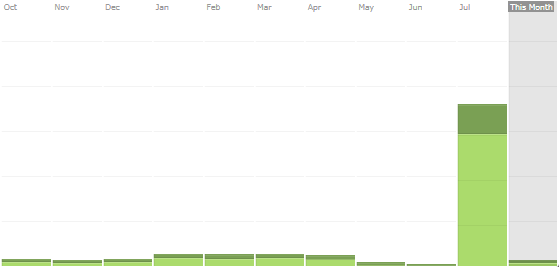
Your boss doesn’t care about your creative genius. She’ll just want to see the money. Or the stuff that’ll turn into money. So make sure you look at the data. I wrote a piece about Dungeons and Dragons and marketing, way back when. Affinities don’t get much more random. When it comes to short-term traffic, it sure worked:
My success metric is sustained growth, though. Zooming out a bit more, it looks like I got a nice surge that lasted for at least a few weeks:
Visitors even stuck around to read the whole thing:
If I were padding anything except my ego, I’d look at sales and other conversions, too.
Of course, before you can even write, you’ve got to convince your boss this is a good idea. Be super-clear. Show her the audience overlap. I’ve found CMOs and similar to be really receptive to random affinity marketing because it fits with traditional best-practices so well. One suggestion before you begin: start with milder stuff. Don’t sell yurts with Burning Man photos if you can do ergonomic furniture. Move on to the photos after you’ve proven the concept.
No autopilot
Again, this strategy can be messy. It’s not perfect. But random affinities will give you a whole different way to access your audience and keep your content fresh. There are three keys takeaways to making random affinities work:
Don’t make this your whole strategy. At most, random affinities can drive 20% of your editorial calendar. You need a few directly-related topics, too.
Set expectations. It’s a lot easier to sustain your effort if no one expects a miracle. Make sure everyone knows this isn’t a miracle marketing solution (like those exist). But also make sure they know that, in the budget spectrum, this stuff’s low-cost and low-risk. Worst case scenario is that no one reads it.
Above all: If you’re still using scripts to spam links on 10,000 blogs or ensuring that your keyword is 3.5% of every page on your site, random affinities are not for you. This is the stuff that blurs the lines between SEO and marketing. Which is why I like it so much. And why it works so damned well.
Sign up for The Moz Top 10, a semimonthly mailer updating you on the top ten hottest pieces of SEO news, tips, and rad links uncovered by the Moz team. Think of it as your exclusive digest of stuff you don't have time to hunt down but want to read!








 After listing your Strengths, Weaknesses, Opportunities, and Threats you should have a pretty good idea where your business stands. From here, it's time to take advantage of this new knowledge.


